
Whenever I speak with banking executives about operational issues, I always pause after mentioning “regulatory reporting” or “compliance requirements” to allow for their predictable reaction of complaints. Their responses are mainly due to the burden of ensuring the accuracy and timeliness of regulatory reporting systems data from a myriad of sources.
Driven by market forces, the speed of mandated regulatory change, and shifts in institutions’ risk profiles, the challenge of updating policies and reporting systems remains a major focus.
Tracking regulatory and compliance policies to ensure they are consistently applied and correctly reported is a challenge for any bank, whether a large, international institution, or a smaller, regional one. It is further complicated by the difficulties in accurate source data processing, frequently changing reporting requirements, and that these changes often result in additional requirements for future reporting.
Managing an increasingly more complicated set of requirements affects financials, operating efficiency, and security in the following ways:
- Reporting requirements change much more regularly, requiring that rules embedded in legacy applications get updated;
- Manual operations to reconcile data add operating costs;
- Added time required to interpret, test, and deploy changes inhibits operating efficiency and speed;
- Undocumented and typically non-secured spreadsheets create traceability and auditability issues; and
- Processing inaccuracies often result in fines.
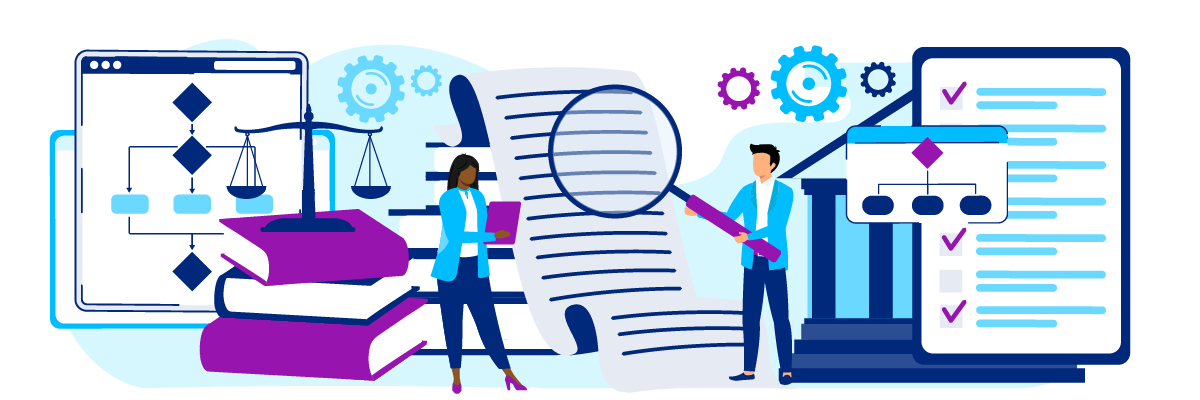
The Decision Automation Solution
To face these challenges, major banks are adopting decision automation. Decision automation enables complex rule management by externalizing rules, simplifying the change process, improving governance, and reducing costs.
In addition, decision automation clearly describes the complicated rules that define business policies and regulatory compliance. These rules are managed through a decision model that documents the granular business logic required for reporting. When decision automation is implemented, banks benefit from improved governance, reporting and operating efficiencies, and greater stability.
Solution Differentiators
Although today’s banks benefit from a variety of decision automation solutions, those with certain key differentiators provide superior functionality and long-term results. Some specific differentiators include centralized regulatory and reporting policies that are automatically converted to code for deployment. Other pluses include consolidated data feeds, automated spreadsheets for reduced manual operations, and trackable changes. Enhanced reporting accuracy and improved rule interpretation are other benefits that simplify reporting. Of course, any solution that can work with a preexisting platform to avoid a “rip and replace” situation is a game changer for any institution.
The Final Word
Banks and financial institutions are subject to hundreds of regulatory and compliance reporting requirements, covering liquidity, earnings, asset quality, capital adequacy, market risk, and other areas. Each requires managing business logic from regulatory reporting policies. Managing and applying accurate logic to multiple data feeds is a challenge that decision automation can easily meet and solve. Decision automation optimizes resources, increases operational efficiency, and improves accuracy, while providing enhanced auditing for market-leading success in today’s highly competitive regulatory environment.
To learn more about how Sapiens Decision can help your business with its regulatory reporting challenges, click here.

ERIC WILKES
Eric Wilkes is Sapiens’ VP of Sales for Sapiens Decision in North America. He has over 20 years of experience in the Banking, Capital Markets, Wealth, and Insurance Technology sectors, with broad expertise in client enterprise and transformation software solutions.
Blackjack remains the table game where player decisions matter most. The house edge can fall below one percent under favourable rules and accurate play, which is why it continues to attract people who prefer skill elements to pure chance.
Rule Variations That Change the Odds
Whether the dealer stands on soft seventeen, how many decks are in the shoe and whether surrender is available all shift the mathematics measurably. Players comparing table conditions before sitting down often Kingia Casino Online to check rule sets by variant. Basic strategy charts are freely available and remain the single most effective adjustment any newcomer can make.
| Rule | Effect on House Edge |
|---|---|
| Dealer stands on soft 17 | Favourable |
| Single deck | Favourable |
| Blackjack pays 6:5 | Unfavourable |
- Check the deck count and dealer rules before sitting
- Keep a strategy chart open while you learn
Even perfect basic strategy leaves the house with an edge, so blackjack rewards good decisions without ever becoming a reliable income. Card counting does not transfer to shuffled online shoes. Play the correct move each hand, keep stakes proportionate, and treat any winning session as fortunate rather than earned.