
What’s inside: Why turning insights into action slows without an explicit decision architecture.
Why this matters: organizations with explicit decision architectures progress from policy to outcomes to optimization faster than their peers.
The Decisioning Layer Blind Spot
Ask a room full of banking, financial services, and insurance (BFSI) executives if their organizations have invested in the technology to make decisions faster, more precise, and more adaptable, and you’ll get a strong show of hands.
Then ask: “Where does that decisioning capability live in your architecture?”
That’s when the nervous laughter starts. What’s going on here?
Much like Peter Drucker’s observation that you can’t manage what you can’t measure, enterprises have invested heavily in improving decision speed and accuracy, but often miss a key insight:
Decisions are first-class enterprise assets. They must be made visible and governed accordingly.
The Visibility Problem
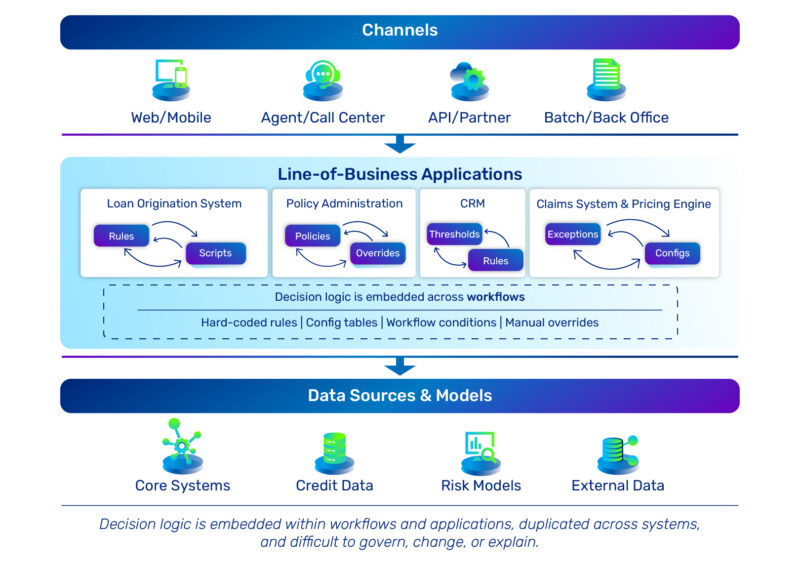
Most organizations improve decisioning by extending line-of-business applications, namely platforms built primarily for workflow, user experience, and system of record. These systems often include rule configurability, but it’s typically constrained to where the application expects it, shaped by the vendor’s data model, and scattered across multiple steps in a process.
The result is predictable: enterprise-critical logic becomes embedded across systems, duplicated, and hard to govern. Teams end up re-implementing the same policy in multiple places, and changes become slow, risky, and difficult to audit end-to-end.
If you can’t see it, you can’t manage it. And if you can’t manage it, you can’t reliably optimize, explain, or automate it, especially with AI.
What It Means to “See” Decisions
Visibility requires a dedicated decisioning layer.
A decisioning layer is the explicit, governed system of record for decision logic, designed to be authored, tested, deployed, monitored, and continuously improved independently of any single workflow or application.
This isn’t about replacing core systems. It’s about separating concerns so decisions can be managed with the same discipline that enterprises already apply to data. Not every organization needs this on day one, but if decision logic is a competitive lever or a compliance risk, it needs to be explicit.
A Quick Example
A lender needs to adjust a credit policy threshold due to macro volatility. In many environments, that “simple change” triggers edits across the loan origination system (LOS), exceptions logic, manual review scripts, and testing cycles, followed by a release window.
With a decisioning layer, the policy change is made once, validated for gaps and conflicts, tested against historical scenarios, promoted through controlled environments, and fully traceable for audit.
What A Decisioning Layer Enables
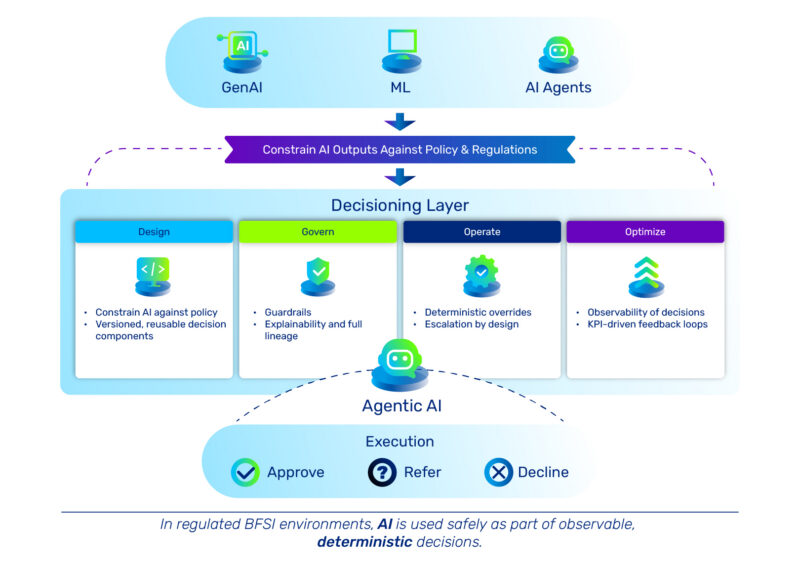
In mature BFSI environments, decisioning platforms typically organize capabilities into four domains. Here’s the executive view:
1. Design
- Express decision logic clearly and reuse it
- A governed repository for decision assets
- No-code/low-code visual authoring with business-expressive notation
- Decomposition of complex decisions into reusable components
- Shared glossary and vocabulary for semantic alignment
- Versioning with immutability for approved releases
2. Govern
- Make decisions provable, auditable, and compliant
- Automated guardrails (gaps, conflicts, and invalid data combinations)
- Approval workflows and separation of duties
- Explainability and traceability for regulators, auditors, and customers
- Full lineage (what changed, when, why, and by whom)
3. Operate
- Run decisions reliably, observe, and integrate them
- Deployment integrity so what runs is what was designed and tested
- Controlled promotion across environments
- Observability (inputs, outputs, paths, variants, and outcomes captured)
- Simulation and scenario testing before production impact
4. Optimize
- Connect business intent to business outcomes
- Champion/challenger and A/B testing
- Feedback loops from outcomes to policy refinement
- Sensitivity and impact analysis
- Dashboards and continuous improvement workflows

Why Executives Care
When decisions are visible, organizations can:
- Adapt to regulatory and market change in days, not quarters
- Reduce operational leakage, rework, and exception volume
- Improve fairness, transparency, and audit readiness
- Reuse decision assets across products, channels, and geographies
- Introduce AI safely, without turning risk and compliance into an afterthought
Eligibility, pricing, underwriting, fraud, claims, and collections aren’t “simple rules.” They are dynamic systems of policy, risk, and customer experience. Treating that backbone as scattered application logic is expensive and it limits agility.
A Quick Diagnostic
If you answer “yes” to three or more of these conditions, you may have a hidden decisioning-layer problem:
- Changing a rule or policy requires a code deployment or release window
- Audit/compliance asks for an explanation and it takes days to produce
- Decision logic lives in multiple systems with no single source of truth
- Predictive models exist, but insights aren’t easily turned into action
- Exceptions and manual reviews keep growing, not shrinking
The AI Layer: Making Visibility Non-Negotiable
As predictive models and gen AI become mainstream, enterprises are learning a hard truth: AI amplifies whatever decision architecture it’s plugged into, good or bad.
In regulated environments, explainability is not optional, and observability is how you prove what happened. In BFSI, where explainability and risk controls matter, AI needs a control plane that:
- Treats models as components inside governed decisions
- Constrains AI outputs against policy and regulatory requirements
- Provides deterministic fallbacks and overrides when necessary
- Captures lineage for audit and investigation
- Enables human-in-the-loop escalation by design
AI doesn’t replace decisions. It enhances them when the decision layer is explicit, governed, and observable.
The Decisioning Layer Takeaway
The takeaway isn’t that workflows, CX platforms, or core systems are obsolete. It’s that they were never designed to be the system of record for decisions.
As AI accelerates and regulatory pressure increases, enterprises will require a decisioning layer that is separate enough to be governed, visible enough to be optimized, and intelligent enough to adapt.
For decades, data has been treated as a first-class asset with its own stack, including storage, governance, lineage, and observability. Decisions are finally heading down the same path.
So the question for leaders is simple:
Can you see your decisioning layer? If not, how will you manage it?
For more information on how Sapiens Decision’s AI-powered, integrated business solutions help our clients adapt swiftly to market changes and stay ahead of the curve, request a demo.

Rafael Goldberg is Head of Sapiens Decision, where he focuses on go-to-market, product strategy and overall operations. With broad experience across global software and consulting operations, Rafael has spent the last 10 years supporting clients implement and adopt enterprise decision automation systems.